


Moving beyond the project dimension and transforming into a stable ecosystem of research, prevention, diagnosis, and care. This is the challenge at the heart of the path launched by Fondazione HEAL Italia, which in Palermo took stock of the results achieved in the field of precision medicine and of the next phase: bringing innovation out of laboratories and into healthcare organizations and the real pathways of patients.
The goal is to build a network capable of connecting universities, IRCCS, companies, laboratories, healthcare organizations, professionals, and local communities, moving beyond the logic of the same treatment for everyone and focusing instead on predictive prevention, early diagnosis, and personalized therapies. A model that brings together genomics, artificial intelligence, big data, biotechnologies, and clinical innovation in order to anticipate disease, improve therapeutic appropriateness, and build increasingly targeted treatments for each individual.
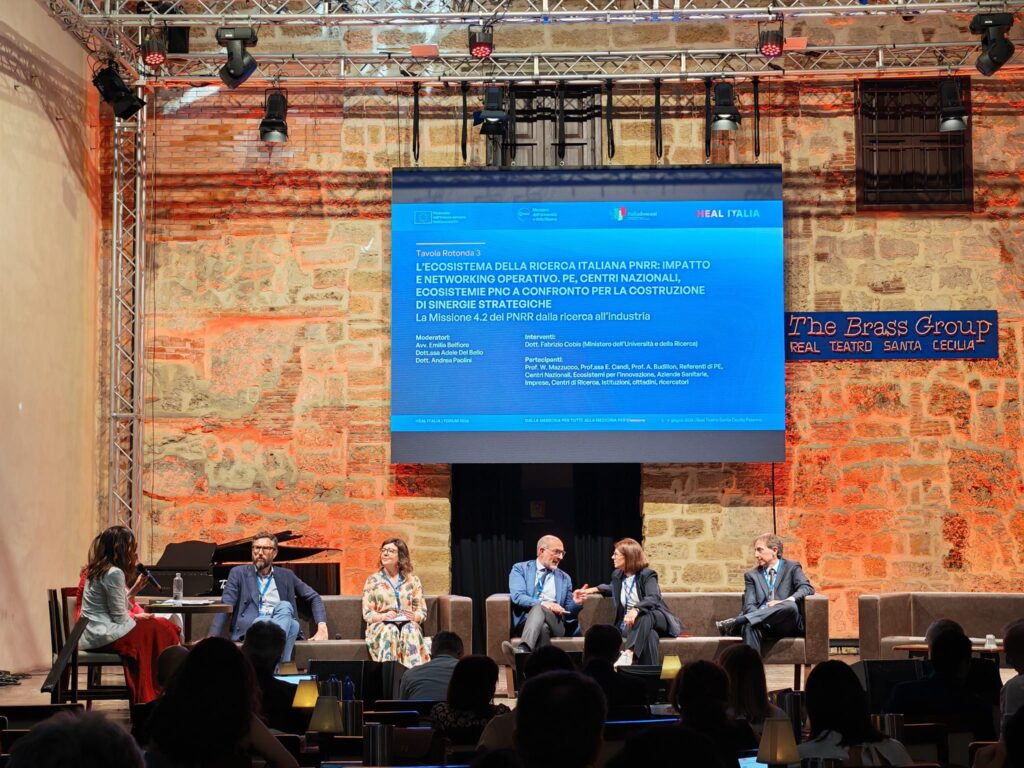
The discussion involved the scientific, healthcare, and managerial communities, bringing together researchers, clinicians, innovation professionals, companies, and institutional representatives around the same table. It was a broad participation, designed to interpret precision medicine not only as scientific progress, but also as an organizational model capable of impacting services, healthcare organizations, and patients’ real care pathways.
Among the participants were also general directors of healthcare and hospital organizations, invited to reflect on how to make research results applicable in healthcare services. Space was also given to communication, with a roundtable dedicated to the relationship between precision medicine, the public, and local communities, led by Fabrizio De Nicola, former general director of several healthcare organizations and trainer in healthcare management, focused on the need to explain this transformation in a correct, understandable, and citizen-oriented way.
From the PNRR to public service
“We are talking about precision medicine, about an investment that exceeded 100 million euros, with a significant share of these resources invested in Southern Italy, more than 46 million euros. All of this has produced an enormous amount of completely new infrastructure. It has strengthened the existing one and created a North-South network unlike anything that had existed before, where specialized centers in the different sectors of precision medicine—from disease prediction to diagnosis with advanced instruments and personalized therapies—have found a network that, for the first time, has seen Palermo as the seat and cradle of this Foundation,” said Massimo Midiri, President of Fondazione HEAL Italia and Rector of the University of Palermo.
“The output of these three years has been 640 researchers, more than 700 scientific papers related to the project, but above all the important involvement of companies. For the first time, a research project is being transformed into something that becomes a public service. Now the final step that we hope to achieve soon is the ministerial blue stamp, so that this Foundation may become the true Italian ministerial research center. Not only to develop other precision centers in Italy, but to create a common thread stretching from Bolzano to Pachino.”
“We want to build a paradigm shift toward a medicine that is no longer for everyone—that is, a generalized medicine, a medicine that spends without truly treating in depth—but a medicine for each individual, capable of seeing the single subject, the single patient, and placing disease and the person at the center of attention. This also means reducing costs. Limiting inappropriate clinical, laboratory, and diagnostic tests and reserving the greatest attention for patients who present an altered genetic profile. Paradoxically, we must begin by working on healthy people, not wait for the sick person,” Midiri emphasized.
From research to prevention
Introducing the transition from scientific production to prevention was Laura Leonardis, Director General of Fondazione HEAL Italia.
“Transforming research into prevention has been our goal since the day we were founded. Personalized treatments and early diagnosis are already an important help. But the real challenge is to understand a person’s risk profile well in advance. The research produced over the past three and a half years is entirely moving in this direction. It is not the isolated work of a single laboratory, but a national network of Core Facilities Labs in which researchers, clinicians, engineers, and innovators collaborate toward the same goal: identifying increasingly targeted protocols for each type of patient.”
“The more than 650 publications produced are not academic results for their own sake, but promises of innovation intended to reach the market and, as soon as possible, Italian hospitals. To accelerate this transition, we have also worked on a managerial, organizational, and administrative line, because without organizations ready to absorb patents, research, and new solutions, innovation risks remaining in a drawer. The real result is staying together, working toward the same objective, and finding a way to keep people healthy for as long as possible.”
Personalized therapies and sustainability
On the clinical level, this change in perspective is linked by Mauro Piacentini, Vice President and Scientific Director of Fondazione HEAL Italia, to the possibility of using genomic analysis, biological markers, digital technologies, and artificial intelligence to build more appropriate care pathways.
“Today, thanks to digital technologies, artificial intelligence, genomic analysis, and biological markers, we are able to target diagnoses and therapies to the individual person. This means moving beyond the idea of a single therapy for all patients with the same disease. Because diseases are much more complex. And within the same diagnosis there may be different subgroups that require different treatments.”
“The advantage is clinical, but also organizational and economic: avoiding the administration of drugs to patients who will not respond to that therapy means reducing unnecessary harm and waste for the National Health Service. The point now is to bring these tools to citizens. For this reason, we have launched a free genetic screening program for breast and ovarian cancer. It is aimed at healthy volunteers, women and men. We want to identify possible predispositions before the disease appears and soon extend this pathway to lung cancer as well. The tools are there; now we must put them into practice and convince people to use them so we can get ahead of the disease.”
Palermo as a driving center
The most concrete impact looks toward Palermo, identified by Midiri as the place where activities currently concentrated elsewhere should be brought, starting with genomic analysis and predictive prevention.
“By the end of the year, a highly specialized center will be created in Palermo dedicated to genomic analysis, that is, the study of the entire genetic heritage of an individual or a microorganism. We are talking about a technology that makes it possible to map DNA, identify mutations and predispositions to diseases, and guide targeted therapies.”
“My intention is to create in our country a major production capacity linked to genomic analysis. What is now done in some Northern centers and in the United States will be done in Palermo. Citizens of Palermo too will be able, through a simple blood sample, to access genomic analysis and learn their own risk category. People with a higher percentage of risk will be monitored more closely. This will allow us, we hope, to intercept at a very early stage diseases that might otherwise become fatal.”
“The project may begin soon, by the end of the year. We are finalizing the agreement with the Policlinico di Palermo in these very days. Once it is signed, I hope that everything else will proceed at a truly rapid pace. The goal is to reduce inequalities between North and South. To bring highly specialized therapies also to our territories and to give this path a strong ethical meaning. Because reducing distances means ensuring that Southern Italy can also have the same opportunities as the major centers in Northern Italy and in the most advanced European and non-European contexts.”
Cretidis: Sicilmedica.com